How to Choose Car Paint Protection for Arizona Heat
Last Updated: November 12, 2026
Quick Summary
The best paint protection for Arizona heat depends on what you need to stop. Paint protection film guards against rock chips and scratches and has UV absorbers that take the sun's damage first, while ceramic coating slows oxidation and water spotting but does not absorb impact. Many drivers in intense sun choose film for the front end and coating for the rest.
- Ultraviolet radiation breaks down the clear coat over time, and dark colors absorb more heat, which speeds that up.
- Paint protection film is a sacrificial physical layer that takes rock chips, road debris and light scratches.
- Ceramic coating does not absorb impact and is not a heat shield, so it does not lower paint temperature.
- Check whether a manufacturer's UV claim is tested to a published standard, and ask for the product data sheet.
- Wash in early morning or evening, never in direct midday sun, and remove tree sap and bird droppings quickly.
Table of Contents
- Why Arizona Heat Is Hard on Vehicle Paint
- Paint Protection Film vs Ceramic Coating: What Each Does Under Intense Sun
- Paint Protection Film Durability in Heat
- Can You Put Ceramic Coating Over Paint Protection Film?
- How to Maintain Paint Protection in Hot Weather
- Checklist for Choosing a Paint Protection Installer
- Booking Your Paint Protection Consultation
- Frequently Asked Questions
Why Arizona Heat Is Hard on Vehicle Paint
Choosing car paint protection for Arizona heat starts with understanding what the sun does to a finish. Vehicle owners often notice paint that looks fine in spring and faded by late summer. Ultraviolet radiation breaks down the clear coat over time, and dark colors absorb more heat, which speeds up that process.
Heat and UV work together. Paint surfaces can reach temperatures far above the ambient air, and repeated cycles of heating and cooling stress the finish. Over months, this shows up as oxidation, dullness and, in some cases, cracking in the clear layer.
Dust, sand and monsoon-season debris add a second layer of wear. Fine particles act like sandpaper when they are wiped or washed, which creates swirl marks that catch the sun and make the finish look older than it is.
Common mistakes to avoid:
- Relying on a single wax coat for the whole year.
- Washing in direct midday heat, which can leave water spots and etch the surface.
- Parking outdoors without shade and assuming the paint will hold up on its own.
Paint Protection Film vs Ceramic Coating: What Each Does Under Intense Sun
Paint protection film (PPF) and ceramic coating are often marketed as if they do the same job. Compare how each option holds up on dark paint under desert sun in our full list of paint protection options for black cars in Arizona heat.
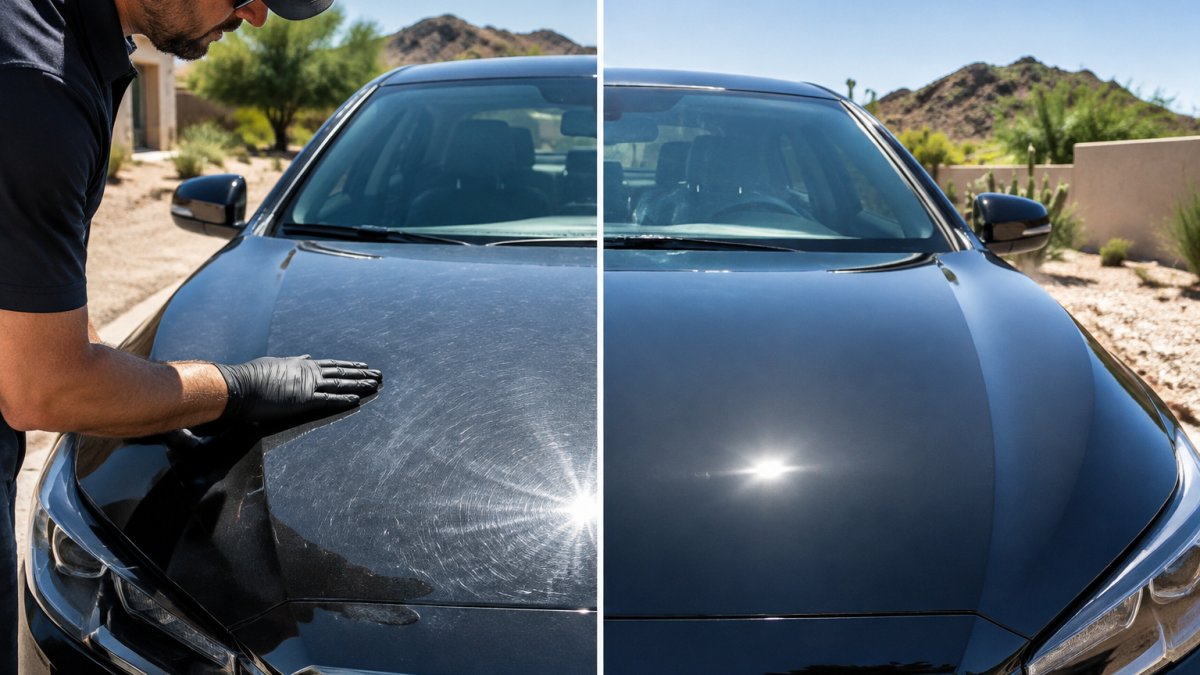
Paint protection film (PPF) is a clear sheet applied to painted panels. It works as a sacrificial physical layer: rock chips, road debris, and light scratches hit the film instead of the clear coat.
Ceramic coating is a liquid protective layer that cures onto the paint surface. It bonds to the clear coat and creates a hydrophobic, slick surface that sheds water, resists bonding of contaminants, and adds gloss.
Here is how the two compare on the factors that matter most in sustained sun:
| Factor | Paint protection film (PPF) | Ceramic coating |
|---|---|---|
| Primary threat addressed | Rock chips, scratches, road debris | Oxidation, water spotting, contamination bonding, gloss loss |
| UV protection mechanism | UV absorbers in the film's top coat; film itself degrades before paint does | UV inhibitors in the cured layer slow clear-coat breakdown |
| Heat resistance | Film can yellow, lift at edges, or degrade under years of extreme sun if low quality | Cured coating is dimensionally stable; durability varies widely by product chemistry |
| Impact resistance | High, that is the point of the product | None |
| Typical thickness | 6-8 mils | Micron-scale |
| Self-healing | Yes, on many films, heat-activated | No |
| Maintenance | Wash, occasional topper; edges need inspection | Wash, periodic topper or boost spray |
| Repair | Replace the damaged panel section | Polish and re-coat, or re-apply |
| Relative installed cost | Higher per panel | Lower per vehicle for full-body coverage |
A few practical distinctions that get lost in marketing:
- UV resistance and heat resistance are not the same claim. A product can block UV without reducing surface temperature, and a product can be heat-stable without blocking UV. Ask which one the manufacturer is actually testing and to what standard.
- Film thickness matters more than brand name. A 6-mil film and an 8-mil film from the same maker behave differently on a highway-driven daily. Thicker is not automatically better, it can be harder to wrap cleanly on complex curves, but it does change the impact budget.
- Coating durability claims are product-specific. A consumer-grade spray coating and a professional multi-layer coating are not comparable, and neither is a coating applied over bare clear coat versus one applied over PPF.
- Warranty language tells you what the maker expects to fail. If the warranty excludes yellowing or edge lifting, that is the failure mode the manufacturer is hedging against.
For most drivers in sustained sun, the decision comes down to what you are trying to prevent.
Watch out: Do not accept a verbal claim that a coating "protects against heat." Ask for the product data sheet and confirm whether the manufacturer is claiming UV resistance, thermal stability, or both, and under what test conditions.
Paint Protection Film Durability in Heat
PPF durability depends on film quality, installation skill and how often the car sits in direct sun.
Ask any installer how they handle curved panels and corners.
Warranty terms vary widely. Ask what the warranty covers (yellowing, cracking, edge lifting) and what voids it, such as a lack of maintenance or a particular cleaning product.
Can You Put Ceramic Coating Over Paint Protection Film?
Some owners apply a ceramic coating over PPF to improve gloss and make cleaning easier. Read why ceramic coatings fail in desert heat before committing to that combination.
Check compatibility before you combine them with your installer. Ask the installer and the coating manufacturer in writing whether the combination is approved. You can also compare hybrid resin and ceramic coating durability if you are considering an alternative layered option.
Confirm the repair process with your installer before you commit.
How to Maintain Paint Protection in Hot Weather
Maintenance is where many owners lose the protection they paid for. Follow a simple routine:
- Wash in the early morning or evening, never in direct midday sun.
- Use a pH-neutral car shampoo and a soft microfiber mitt.
- Rinse thoroughly and dry with a clean microfiber towel to avoid water spots.
- Re-apply any topper or sealant product as the manufacturer recommends, usually every few months in intense sun.
- Park in shade or a garage when possible.
- Inspect edges and corners of film monthly for lifting or discoloration.
Watch out: Tree sap and bird droppings can etch paint within days in Arizona heat. Remove them as soon as you see them.
Checklist for Choosing a Paint Protection Installer
Most buying mistakes in paint protection happen before the installer touches the car. The product is chosen poorly, the coverage area is not defined, the warranty is not read, or the paint is not prepared correctly. Use this checklist to evaluate both the product and the shop, and get the answers in writing.
Product and specification
- Ask for the exact film or coating brand, product line, and version. "We use a premium film" is not an answer.
- Request the product data sheet and confirm the film thickness (in mils) or the coating's solids content and number of layers.
- Confirm what UV protection the manufacturer actually claims, and whether it is tested to a published standard or is a marketing statement.
- For film, ask whether it is top-coated with a clear layer that carries UV absorbers, and whether it is self-healing.
- For coating, ask how many layers are applied, the cure time, and the expected maintenance interval.
Coverage and scope
- Get a written quote that lists every panel covered. "Full front" means different things at different shops, confirm whether it includes the full hood, fenders, bumper, headlights, mirrors, and A-pillars, or only a partial hood and bumper.
- Ask whether edges are wrapped or cut at the panel edge. Wrapped edges look cleaner and resist lifting better; cut edges are faster and cheaper.
- Confirm whether the quote includes removal of badges, handles, or trim, or whether those are left in place and cut around.
- Ask what happens to pre-existing chips, scratches, or touch-up paint under the film.
Paint preparation
- Ask what decontamination is included, clay bar, iron remover, tar removal, before film or coating goes on.
- Ask whether paint correction (polishing) is included, and at what level. Film and coating lock in whatever is underneath, so swirls and scratches present at installation stay visible.
- Confirm how the shop handles existing damage: does it require repair before installation, and who pays for it?
- Ask about the installation environment, a controlled, dust-managed bay versus an open shop floor affects how much debris ends up under the film.
Warranty and workmanship
- Get the warranty in writing and read the exclusions. Common exclusions include yellowing, edge lifting, cracking, and damage from automated car washes or certain chemicals.
- Confirm who honors the warranty, the installer, the film manufacturer, or both, and what the remedy is (repair, replacement, or refund).
- Ask what voids the warranty: specific cleaning products, automatic brush washes, pressure washing at close range, or failure to return for inspections.
- Ask how many vehicles of your make and model the shop has completed in the past year, and request to see finished examples with wrapped edges and complex curves.
- Confirm the shop's repair process if film or coating fails, whether they replace a single panel, re-coat, or require full removal.
Questions specific to sustained sun and heat
- Ask how the installer handles edge sealing on curved panels and corners, since heat and washing are where lifting usually starts.
- Ask whether the film or coating has a documented performance history in hot, high-UV climates, and request the manufacturer's stated durability under those conditions.
- Confirm the recommended maintenance schedule for your climate, including how often topper products should be reapplied.
Red flags
- A quote given without seeing the vehicle or confirming coverage area.
- A warranty described verbally but not provided in writing.
- Reluctance to share the product data sheet or the brand and product line.
- No discussion of paint preparation before installation.
- A price significantly below local market for the stated coverage, it usually means less prep, cut edges, or a lower-grade product.
Watch out: A warranty that excludes yellowing and edge lifting is telling you those are the expected failure modes; factor that into your comparison rather than treating all warranties as equivalent.
Booking Your Paint Protection Consultation
Every vehicle, paint condition and driving pattern is different, so a written assessment is the most reliable starting point. Guardian Automotive Coatings can review your vehicle, the parts you want protected and how it is used day to day.
You can request a Hybrid Resin Coating quote to get started, or read our guide to ceramic coating durability in Arizona heat before you decide.
Protecting paint in Arizona heat is a practical decision, and the right choice depends on your vehicle, budget and how much sun it sees. Guardian Automotive Coatings offers a Hybrid Resin Coating designed for long-term UV exposure, with repairs and reapplication available. Get A Quote from our team to talk through your options.
Frequently Asked Questions
What type of car paint protection is the most effective in Arizona heat?
For Arizona heat, the most effective option depends on what you need most. Paint protection film and ceramic coatings protect against different threats, so the right choice depends on what you need most. Guardian Automotive Coatings can review your vehicle, parking conditions and driving habits to recommend a system and provide a quote on its website.
Is paint protection film or ceramic coating better for a hot, sunny climate?
Neither product is automatically better in a hot, sunny climate. Ceramic coatings and paint protection film address different concerns, with film focused on physical impacts and coatings on surface properties. Ask any installer for product data sheets and warranty terms before deciding.
Can you apply ceramic coating over paint protection film?
Yes, a ceramic coating can usually be applied over paint protection film. Compatibility depends on the specific film and coating products, so confirm with your installer that both are approved to work together. Proper curing time before washing is important, and the surface should be clean and free of contaminants before the coating is applied.
How long does paint protection film last in intense sun?
Paint protection film lifespan depends on film quality, installation, parking and maintenance. Check the manufacturer warranty for the specific product, and ask your installer what UV and heat performance testing supports their recommendations.


