Does Ceramic Coating Block Harmful UV Rays?
Last Updated: November 21, 2026
Quick Summary
Does ceramic coating block harmful UV rays? Partly, a ceramic coating absorbs and reflects some UV energy, slowing paint oxidation and fading, but it does not block ultraviolet radiation the way sunscreen or window film does. It is a sacrificial barrier, not a shield, so your clear coat still receives UV, just less of it.
- UVB runs roughly 280 to 315 nanometers and is mostly absorbed in the upper few micrometers of the clear coat.
- UVA runs roughly 315 to 400 nanometers and penetrates deeper into the color coat, driving long-term fading.
- Paint protection film is the stronger UV blocker because it is a physical urethane layer that absorbs UV before it reaches paint.
- Ask providers what wavelength range was tested and how many hours of accelerated UV and moisture exposure the film endured.
- Guardian's hybrid resin system maintains over 99% integrity after 2,000 hours of UV and moisture exposure.
Table of Contents
- Does Ceramic Coating Protect Against UV Rays?
- How Ceramic Coating Interacts With Sunlight and UV Exposure
- How Long Does Ceramic Coating Last Under UV Stress?
- Ceramic UV Coating for Headlights: What It Can and Cannot Do
- Ceramic Coating vs. Paint Protection Film for UV Defense
- Ceramic Coating Myths vs. Facts About UV Protection
- Get a Quote for UV Protection That Fits Your Vehicle
- Frequently Asked Questions
Does Ceramic Coating Protect Against UV Rays?
Does ceramic coating block harmful UV rays? Partly, and the "partly" matters. A ceramic coating slows UV damage to your paint, but it does not block ultraviolet radiation the way sunscreen or window film does. The gap between "UV resistance" and "UV blocking" is what decides whether your clear coat survives years of desert sun.
Here is the short answer. Ceramic coatings, built on silicon dioxide (SiO₂), form a semi-permanent protective layer that absorbs and reflects some UV energy. That slows paint oxidation and fading. It does not stop UV rays from reaching the paint underneath.
Why the confusion? Marketing. Many product labels imply full UV blocking. In practice, a coating is a sacrificial barrier, not a shield.
Below, we break down what a coating actually does, how long it lasts under UV stress, and how it compares with paint protection film and wax. The goal is realistic expectations, not hype.
How Ceramic Coating Interacts With Sunlight and UV Exposure
Sunlight reaches automotive paint in three ways: visible light, heat, and ultraviolet radiation. The ultraviolet portion is what drives most chemical breakdown of the clear coat, and it splits into two bands that behave differently at the surface.
- UVB runs roughly 280 to 315 nanometers. It is the shorter, higher-energy band. Most of it is absorbed in the upper few micrometers of the clear coat, where it breaks polymer bonds and produces the chalky, oxidized surface that looks like dull haze.
- UVA runs roughly 315 to 400 nanometers. It is longer, lower-energy, and penetrates deeper, through the clear coat and into the color coat and, on some substrates, the base layers. UVA is the band most associated with long-term color shift and fading rather than surface chalk.
Both bands attack the clear coat, the thin transparent layer above your color coat. That layer is the paint system's built-in UV absorber, and once it degrades, the color coat underneath has no defense.
A ceramic coating works on the surface. The SiO2 layer is hard, slick, and mildly UV-resistant. It takes the first hit, so the clear coat takes less. That is UV resistance. The mechanism is a combination of surface absorption and scattering: some UV energy is taken up by the coating and dissipated as low-grade heat, and some is scattered at the coating-air interface before it reaches the paint.
UV blocking is different. True blocking means stopping transmission almost entirely. Window tint and paint protection film do that. A paint coating does not. When a label claims a coating "blocks UV rays," the honest reading is that it reduces transmission across part of the spectrum, not that it stops it.
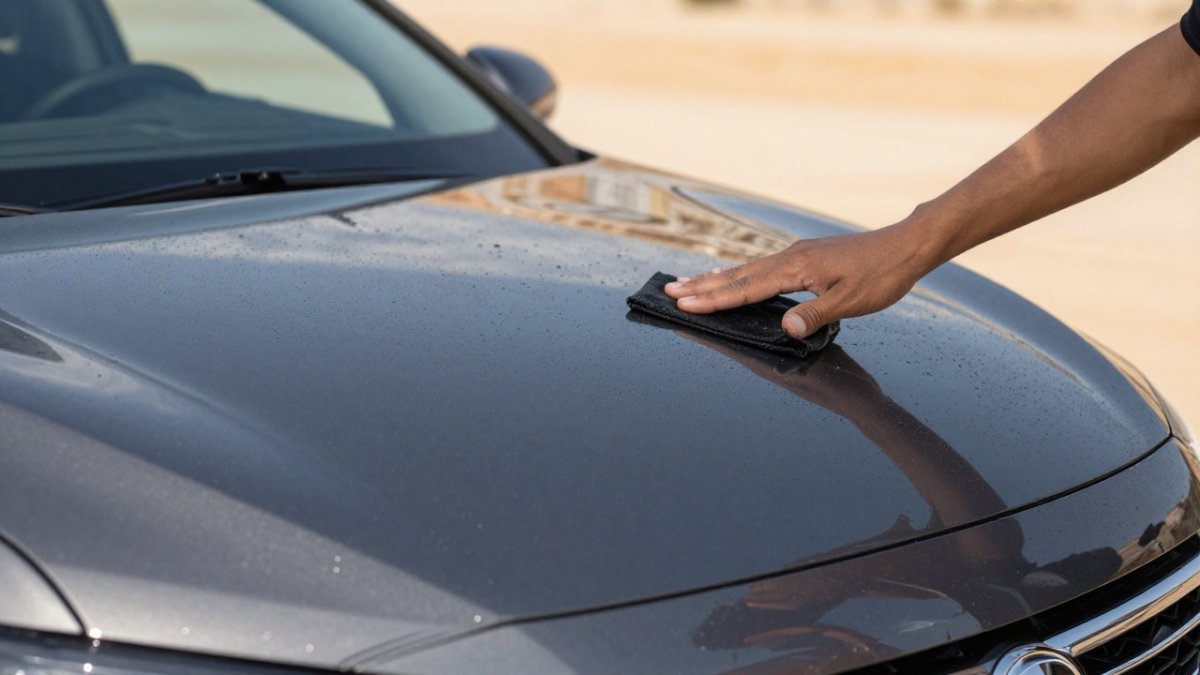
Three things follow from this:
- The coating absorbs some UV energy and disperses it as heat.
- The clear coat still receives UV, just less of it, and UVA still reaches deeper layers.
- Hydrophobic properties and chemical resistance slow the wear that UV accelerates.
So a coating buys time. It does not buy immunity. For luxury finishes, can ceramic coating stop sun damage on luxury paint explains what to expect. For a deeper look at how UV exposure drives fading, see does ceramic coating prevent paint fading.
If you want to know what a specific product actually does, ask for spectral transmission data, the percentage of UV passing through a cured film across the UVA and UVB ranges. A single "blocks UV" percentage with no wavelength range and no test method is a marketing number, not a measurement.
How Long Does Ceramic Coating Last Under UV Stress?
Durability depends on sun exposure, not just the calendar. A garage-kept car and a truck parked outside all day in Phoenix will not see the same coating life. Heat and UV both break down the coating's polymer structure over time.
Expect these factors to shorten coating life:
- Daily direct sun with no shade or cover
- High surface heat, which speeds curing and degradation
- Dust and debris that get dragged across the surface during washing
- Harsh wash chemicals that strip the top layer
Maintenance stretches it. A gentle hand wash, a pH-neutral soap, and periodic inspection keep the protective layer intact. When water stops beading, the coating is telling you something.
Watch out: skipping maintenance and using automatic brush washes is the fastest way to kill coating performance. The brushes create light scratches, and those scratches give UV and water a path into the clear coat.
If you want the full picture on heat-driven failure, read why ceramic coatings fail in desert heat.
Ceramic UV Coating for Headlights: What It Can and Cannot Do
Headlights age faster than paint. Most modern lenses are polycarbonate, and polycarbonate yellows under UV. A ceramic UV coating for headlights adds a thin protective layer that slows that yellowing and keeps the lens clearer longer.
What it can do:
- Slow oxidation and yellowing on plastic lenses
- Shed water so grime rinses off easier
- Add a small layer of scratch resistance
What it cannot do:
- Reverse existing yellowing. Once the plastic hazes, you need a polish or restoration first.
- Replace a dedicated lens film on high-exposure vehicles.
- Block UV completely. It reduces exposure, it does not eliminate it.
The same logic applies to a panoramic sunroof and glass protection. Coatings help glass shed water and resist contaminants. They do not replace tint or film for heat and UV rejection.
Ceramic Coating vs. Paint Protection Film for UV Defense
Paint protection film (PPF) is a physical urethane layer. Ceramic coating is a chemical layer. That difference drives everything about UV defense.
PPF is the stronger UV blocker. The film itself absorbs UV before it reaches the paint, and quality films carry UV-blocking top coats. Ceramic coating resists UV but lets more through.
Here is how the main options compare:
| Method | UV Defense | Durability | Appearance | Maintenance |
|---|---|---|---|---|
| Ceramic coating | Moderate (resists, does not block) | Years with care | High gloss, deep color | Gentle hand wash |
| Paint protection film | High (physical barrier) | Long-term | Gloss or matte | Film-safe wash |
| Wax | Low (short-lived) | Weeks | Warm gloss | Frequent reapply |
| Sealant | Low to moderate | Months | Slick gloss | Periodic reapply |
| Clear coat alone | Minimal | Factory life | Factory finish | Wash and protect |
Neither coating nor film is "best" in isolation. Many owners combine them: film on high-impact panels, coating on top for gloss and easy cleaning. If you are weighing the wider set of options, best ceramic coating alternatives 2026 covers the field.
Ceramic Coating Myths vs. Facts About UV Protection
Myths about UV protection are where owners get burned, sometimes literally. Here is what holds up and what does not, plus the evidence question most guides skip.
Myth: Ceramic coating blocks all UV rays. Fact: It resists UV. It does not block it fully. A coating reduces exposure to your clear coat; it does not stop it. Claims of "100% UV blocking" on a paint coating should be treated as marketing until backed by spectral data.
Myth: Any coating with "UV" on the label is equal. Fact: Formulation and testing vary widely. The UV absorber package, the resin chemistry, and the cured film thickness all change how much UV is attenuated and for how long.
Myth: A coating means you can skip washing. Fact: Contaminants and dust wear the layer down. Care extends coating life.
Myth: Coating makes repainting unnecessary. Fact: Coatings slow damage. They do not prevent rock chips or deep scratches.
Myth: Ceramic coating and window tint are the same job. Fact: Paint coatings protect paint. Window films protect interiors and occupants from heat and UV. Different products, different surfaces, different results. A coating on your hood does nothing for the UV reaching your dashboard through the windshield.
What most guides miss is the testing question. UV protection is measured, not asserted. The common laboratory methods are accelerated weathering under fluorescent or xenon-arc lamps that simulate sunlight, with samples exposed for a set number of hours and then checked for gloss retention, color shift, and film integrity. A real specification tells you the test method, the exposure duration, and the pass criterion. A slogan does not.
Ask any provider three questions before you buy:
- What wavelength range was tested, UVB only, or UVA and UVB?
- How many hours of accelerated UV and moisture exposure did the film endure, and what was measured after?
- Was the test run by an independent lab, and can you see the report?
A common pattern is a product that performs well in UVB-range testing and is then marketed as if the result covers the full UV spectrum. The number is real; the claim built on it is not.
Our hybrid resin system is independently tested and maintains over 99% integrity after 2,000 hours of UV and moisture exposure.
Get a Quote for UV Protection That Fits Your Vehicle
Every vehicle and every parking situation is different, so pricing depends on the vehicle and its conditions. For current prices or a quote, visit the Guardian Automotive Coatings website.
Our hybrid resin coating delivers up to 20 times more UV protection than ceramic coatings, exceeds 660 pounds per square inch in pull-off tests, and holds a 99.8% gloss reading. It can be repaired and reapplied after damage.
Ready to protect your finish? Get a quote from Guardian Automotive Coatings.
The sun will not negotiate with your paint. If you want a coating that holds its integrity under real UV and moisture stress, and that can be repaired instead of replaced, Guardian Automotive Coatings is built for exactly that. Our hybrid resin system delivers up to 20 times more UV protection than ceramic coatings, keeps a mirror-like finish with a 99.8% gloss reading, and can be reapplied after damage. Get started with Guardian Automotive Coatings and give your vehicle long-term protection against the desert sun.
Frequently Asked Questions
Does ceramic coating block UV rays or only reduce their effects?
Ceramic coatings reduce the effects of UV radiation rather than completely block it. The SiO₂-based layer absorbs and scatters some ultraviolet radiation, slowing oxidation and fading, but it is not a total barrier like a window film or paint protection film. Realistic expectations matter: a quality coating extends paint life and preserves gloss, but prolonged sun exposure still reaches the clear coat. For full blocking, combine a coating with PPF or window tint on glass surfaces.
How long does ceramic coating provide UV protection?
Most consumer ceramic coatings offer meaningful UV resistance for one to three years, depending on product grade, climate, and maintenance. In intense sun regions, degradation accelerates, so reapplication every 12 to 24 months is common. Professional-grade coatings may last longer, but UV performance fades as the layer wears. Regular washing with pH-neutral shampoo and periodic inspections help you know when the coating needs refreshing.
Can ceramic coating prevent car paint from fading?
It can slow fading but not prevent it entirely. Ceramic coating UV resistance reduces oxidation and color shift by limiting UV reach to the clear coat, yet the paint still ages under constant sun. Fading also comes from heat, environmental contaminants, and improper washing. A coating buys time and preserves gloss, but combining it with shade parking, a car cover, and PPF delivers the most reliable fade protection.
Is there a downside to ceramic coating for UV protection?
Yes. Ceramic coating does not block all UV rays, can be sensitive to harsh chemicals, and needs proper washing to avoid water spots. Application errors can leave high spots or streaks, and removal often requires polishing. It also will not stop rock chips or deep scratches, so it is not a substitute for paint protection film. Weigh these limits against the gloss and hydrophobic benefits before committing.


